Daniel Brooks
CEO, multi-site hospice
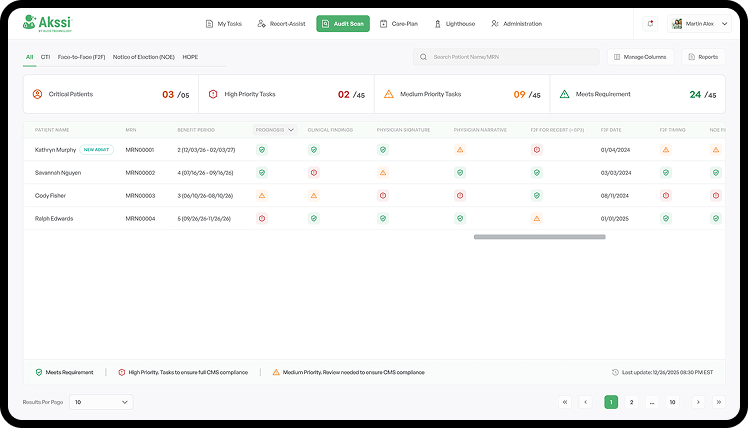
Akssi™ works with your EMR to identify documentation and eligibility gaps before they surface during CMS review, helping ensure decisions are defensible and follow-through is complete as your organization grows.

See where risk is building across your patients and how Akssi fits into your current workflows
.png)
As hospice organizations grow, small inconsistencies across teams and locations accumulate. As variability increases, exposure follows in the form of ADRs, denials, clawbacks, and audits.
This results in $800K–$1.7M+ in potential exposure for every $10M in claims
Most organizations only see these issues after submission, when correction is more difficult and more costly.
Our platform works with your EMR to identify documentation and eligibility gaps across patients and claims, so decisions are
consistent and defensible before they are reviewed, resulting in:
Reduce recertification time by 2–4 hours and minimize chart audit effort
Address gaps before they result in denials or clawbacks
Limit legal, consulting, and internal time spent managing audits
Daniel Brooks
CEO, multi-site hospice
James Carter
Chief Operating Officer, mid-size hospice
Richard Foster
VP, Clinical, multi-site hospice
Daniel Brooks
CEO, multi-site hospice
James Carter
Chief Operating Officer, mid-size hospice
Richard Foster
VP, Clinical, multi-site hospice
Akssi pulls fragmented data from across your EMR without additional work or disruption to your clinical workflows. EMRs store documentation, but do not identify patterns of risk. Akssi fills that gap.
Implementation is easy, with very little effort on the part of your staff.
Patterns in documentation and eligibility decisions across claims.
Documentation does not consistently support patient decline.
Customers see time savings and risk reduction within the first two weeks of implementation.
Yes, Akssi works with Homecare Homebase, as well as other EMRs such as MatrixCare, Careficient, PointClickCare and Wellsky. Akssi can also integrate with any other hospice EMR.
Stay informed with expert articles, case studies, and training guides designed to help your team work smarter and stay compliant.
The Other Side of SSVI: What Hospice Leaders Should Watch Beyond Non-Hospice Spending Much of the industry discussion around CMS’s new Service and Spending Variation Index, or SSVI, has focused on non-hospice spending. But the utilization side deserves just as much attention. CMS is also looking at patterns such as long lengths of stay, high live-discharge rates, and beneficiaries returning to the same hospice shortly after discharge. Those patterns do not prove that a hospice made the wrong decision, but they can become flags that lead CMS to look more closely at the eligibility, recertification, and discharge decisions underneath the claims.
Read More
Stop Looking for Decline. Start Seeing the Patient. Every 15 days, federal regulation requires your interdisciplinary group to review each patient's plan of care. That's not a best practice. That's 42 CFR 418.56(d), and surveyors cite against it. What that review actually looks like inside a growing hospice is a lot less standardized than most leaders think. In plenty of organizations, IDT prep has quietly turned into a search. A nurse opens the chart hunting for evidence the patient is declining, because decline is what survives an audit. That's a poor use of a clinician's hour. It's also, and this is the part that usually gets missed, a poor compliance strategy.
Read More
Why Operational Consistency Is Your Best Defense Against Hospice Audit Risk Hospice organizations rarely struggle because clinicians make poor eligibility decisions. More often, appropriate decisions become harder to defend as documentation, clinical reasoning, and supporting evidence become less connected over time. Growth increases the number of patients, clinicians, locations, and decisions an organization must manage. Without a structured way to identify hidden gaps before they become exposure, decision risk quietly grows alongside the census.
Read More
Feb 18-20, 2026
November, 18 2025
Nov 2-4, 2025
Sep 8-9, 2025
Dec 8, 2024
Aug 25-26, 2025
May 19-20, 2025
Sep 15-17, 2024
Feb 29, 2024
April 16-17, 2026
April 19-21, 2026
September 1-3, 2026
June 22, 2026
August 10-11, 2026
October 28-30, 2026
Review your recertification workflows
See where gaps are forming
Understand how Akssi reduces your risk